
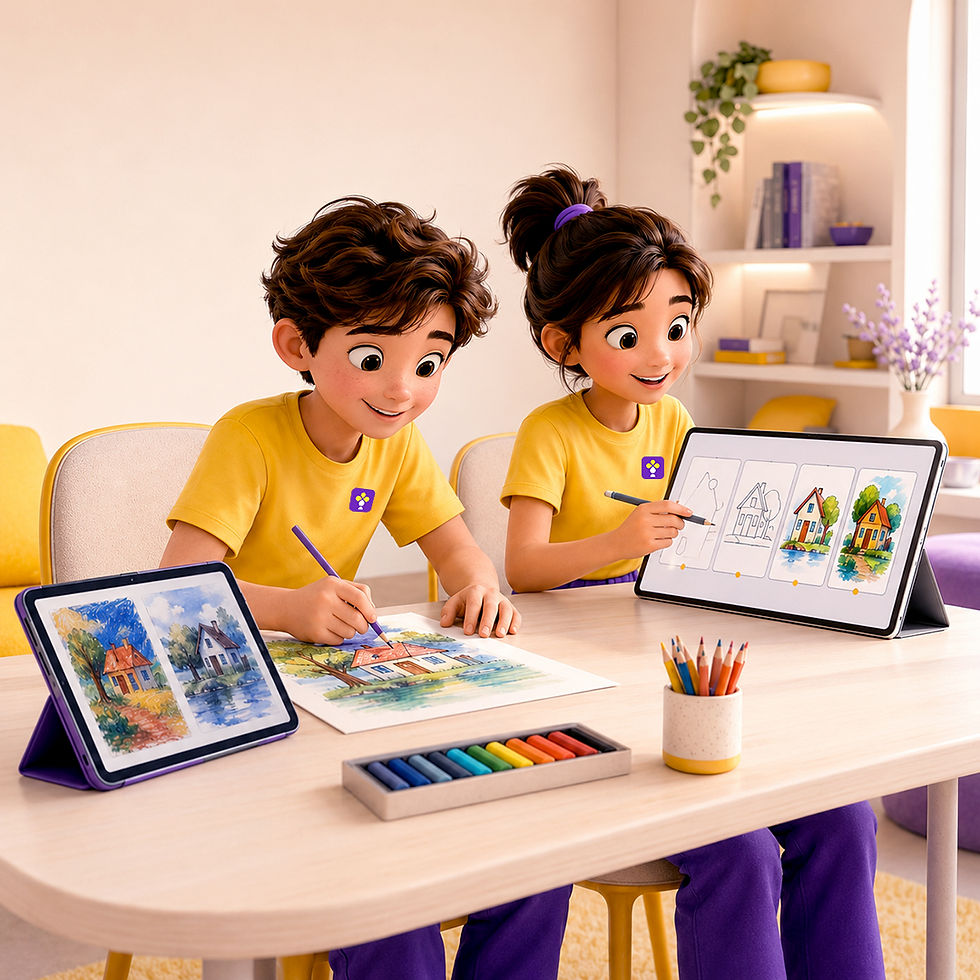
Digital Drawing Books for Kids, Students and Beginners
Explore structured digital drawing books designed to help learners practise drawing and painting according to their age, medium, ability and learning level.
RangCanvas brings together currently available Static Digital Drawing Books and the upcoming AI-Guided Digital Drawing Book ecosystem, creating a clear path from visual practice to more guided and interactive art learning.
Instant digital access • Age-appropriate learning • Multiple art mediums • Printable practice resources • Learn from anywhere
What Is a Digital Drawing Book?
A digital drawing book is an art-learning and practice resource that learners can access through a phone, tablet, laptop or computer. Depending on its format, it may contain completed artwork, matching outline drawings, printable practice sheets, organised learning levels, step-by-step demonstrations, video guidance or interactive learning support.
Unlike an ordinary collection of unrelated online images, a properly designed digital drawing book organises art practice around a learner’s age, current ability, preferred medium and learning objective.
RangCanvas is developing a complete Digital Drawing Book ecosystem with two primary formats:
-
Static Digital Drawing Books, which are currently available.
-
AI-Guided Digital Drawing Books, which are being developed for future guided learning.

Explore the Two Digital Drawing Book Formats
Two Formats, One Structured Learning Ecosystem
RangCanvas Digital Drawing Books are organised into two distinct formats. They serve different learning needs and should not be confused with one another.
Static Digital Drawing Books | Available Now
RangCanvas Static Digital Drawing Books are downloadable or digitally accessible art-practice resources containing curated colour-reference artwork and corresponding outline drawings.
Depending on the selected book, learners may practise:
-
Oil pastel drawing
-
Watercolour painting
-
Acrylic painting
-
Poster colour
-
Pencil sketching
-
Subject drawing
-
Composition
-
Scenery
-
Festival drawing
-
School-project themes
-
Animals, careers, city life and other subjects
These books allow students to view the colour artwork on a screen and use the corresponding outline as a practice reference where included.
AI-Guided Digital Drawing Books | In Development
The upcoming RangCanvas AI-Guided Digital Drawing Book is being designed to provide a more guided learning experience.
Planned capabilities may include:
-
Step-by-step drawing guidance
-
Video-supported learning
-
Multilingual explanations
-
Drawing-stage demonstrations
-
Practice support
-
Learning checks or quizzes
-
Age- and level-based guidance
-
More personalised learning pathways
These capabilities are planned or under development and should not be presented as currently available until they are officially launched.
How Does a Digital Drawing Book Work?
A digital drawing book gives students an organised reference for art practice without requiring them to depend on random images from multiple websites.
The basic process is simple.
01
Select the Correct Book
Choose according to:
• Student’s age • Current drawing ability • Preferred medium • Learning level • Type of drawing • Practice objective
02
Access the Digital Resource
Open the book on a:
• Smartphone • Tablet • Laptop • Desktop computer • Compatible digital display
A tablet or laptop generally provides a more comfortable viewing size during physical drawing practice.
03
Observe the Reference Artwork
The student studies:
• Main shapes • Placement of objects • Composition • Colour selection • Foreground and background • Visual balance • Medium-specific treatment
04
Use the Matching Outline
Where the selected product includes printable outline drawings, students can use them to practise colouring, painting, pencil control or visual understanding.
05
Recreate and Practise
Students can recreate the artwork using appropriate physical materials such as:
• Oil pastels • Watercolours • Acrylic colours • Poster colours • Pencils • Crayons • Colour pencils
Who Can Use a Digital Drawing Book?
Digital drawing books can support different learners when the book’s difficulty and format are selected carefully.
Age-appropriate drawing and colouring resources can help children practise shapes, colours, pencil control and simple visual subjects.
Children
Students can use structured drawing books for:
• Regular art practice • School projects • Drawing examinations • Art competitions • Festival assignments • Subject and scenery practice • Skill development
School Students
Teenagers can work on more detailed compositions, watercolour paintings, city scenes, still life, advanced scenery and medium-specific techniques.
Teenagers
Adults beginning their art journey can use suitable foundation-level books to practise without feeling pressured by advanced professional material.
Adult Beginners
Parents can select organised, age-appropriate practice resources instead of repeatedly searching for disconnected drawing images.
Parents
Teachers may use relevant books as supplementary references for classroom assignments, practice planning or student recommendations, subject to the product’s permitted usage terms.
Art Teachers
Watercolour Painting Books
Watercolour books introduce learners to transparent colour, brush control, water management, scenery, figures, objects and visual atmosphere.
Students should begin with simpler compositions before moving toward detailed city paintings, festival scenes and complex compositions.

How to Choose a Digital Drawing Book by Age and Ability
A book should challenge a student without making the learning experience frustrating. These are general recommendations. Always check the individual product page for its intended age, difficulty and included resources.
Colour recognition, tracing, pencil control and simple printable activities
Easy colouring, simple shapes, objects and beginner creative activities
Simple oil pastel subjects and easy scenery
Structured subjects, compositions and medium development
Watercolour, detailed compositions, city scenes and advanced subjects
Higher-level painting, composition, sketching and specialised mediums
Foundation books selected by ability rather than age
What Is Inside a RangCanvas Static Digital Drawing Book?
What Can Learners Expect Inside?
The exact contents vary by product. Visitors should always review the individual product description before purchasing.
Some current books contain 20 colour-reference artworks and 20 corresponding outline drawings, while other product types may contain different quantities and formats.
Product contents vary: Number of drawings, page dimensions, file format, print eligibility, age recommendation and included learning materials may differ from one book to another. Check the individual product page before purchasing.
Depending on the selected RangCanvas book, it may contain:
-
Curated completed colour artwork
-
Matching outline drawings
-
Printable practice pages
-
Age or level recommendations
-
Medium-specific subjects
-
Scenery and composition practice
-
School and festival topics
-
Digital access instructions
-
Reusable practice opportunities, subject to the product terms
-
A structured collection instead of disconnected images
Benefits of Learning with Digital Drawing Books
Structured Selection
Books can be organised around a medium, learning level, theme or age group, making practice more purposeful.
Instant Digital Access
Digital products remove physical shipping delays. Access and delivery depend on the terms and instructions provided with the selected product.
No Physical Book Damage
Because the primary resource is digital, learners do not need to worry about damaging or losing a single physical reference book.
View on Multiple Screen Types
Students can view resources on compatible phones, tablets, laptops or computers.
Printable Practice
Where printing is included and permitted, students can print practice pages according to their learning needs.
Repeatable Learning
Learners may revisit the digital resource and repeat relevant exercises, subject to access and usage terms.
Age- and Level-Based Choice
Parents can select books that are closer to the learner’s current stage instead of using one generic book for everyone.
Multiple Art Mediums
The RangCanvas ecosystem can support progression across oil pastel, watercolour, acrylic, poster colour and pencil sketching.
Learning from Anywhere
Students can practise at home, during holidays or wherever they have access to the necessary device and physical art materials.
Complements Teacher Guidance
A digital drawing book can support regular practice, but it does not replace thoughtful correction, encouragement or professional teacher guidance when those are needed.
The RangCanvas Structured Learning Approach
More Than a Collection of Drawing Images
Searching online can produce thousands of attractive drawings, but those images are not necessarily organised for a particular learner.
A structured learning resource should answer:
-
Is the drawing appropriate for the student’s age?
-
Does it match the learner’s current ability?
-
Which medium should be used?
-
Is the composition too simple or too advanced?
-
What should the learner practise next?
-
Is there a progression from one level to another?
The objective is not to make every student copy in exactly the same way. References should support observation, control and understanding while leaving room for students to develop their own creative decisions.
Simple shapes and subjects
Basic colour application
Subject drawing
Simple scenery
Composition
Medium-specific development
Detailed and advanced artwork
Consideration | RangCanvas Digital Drawing Book | Random online images |
|---|---|---|
Support | Connected to RangCanvas resources | Usually no structured path |
Progression | Can connect to the next learning level | Usually absent |
Usage rights | Governed by clear product terms | Copyright may be unclear |
Print suitability | Explained on relevant products | May be unknown |
Matching outlines | Included in selected books | Often unavailable |
Difficulty | Can be organised by level | Highly inconsistent |
Medium | Selected for a particular art medium | May be unclear |
Age guidance | May include age or level recommendations | Often unavailable |
Organisation | Grouped into a defined book or learning theme | Usually disconnected |
Digital Drawing Books vs Random Online Images
Why Use a Structured Book Instead of Random Images?
Random inspiration can still be useful, but it should not be confused with a complete learning system.
Feature | Static Digital Drawing Book | AI-Guided Digital Drawing Book |
|---|---|---|
Human teacher replacement | No | No |
Best suited for | Independent visual practice | Learners needing step by step guidance |
Quizzes or learning checks | Not standard | Planned |
Multilingual guidance | Not a standard feature of all static books | Planned |
Video guidance | Limited | Yes |
Step-by-step guidance | Limited to what the product includes | Planned as a major feature |
Matching outlines | Available in relevant products | Planned depending on product |
Colour references | Available in relevant products | Planned |
Main format | Digital artwork and practice resources | AI-Guided learning concept: video tutorial+ static drawing |
Current availability | Available now | In development |
Static vs AI-Guided Digital Drawing Books
What Is the Difference Between Static and AI-Guided Books?
The exact features of AI-Guided Digital Drawing Books will be confirmed at launch. Planned features should not be represented as currently available.
Drawing Books, Colouring Books and Preschool Books Are Different
Choose the Correct Product Family
Not every printable art resource should be classified as a Digital Drawing Book.
Digital Drawing Books
Best for learners practising drawing or painting through reference artwork, outlines and medium-specific subjects.
Examples:
-
Oil Pastel Drawing Books
-
Watercolour Painting Books
-
Acrylic Painting Books
-
Poster Colour Drawing Books
-
Pencil Sketching Books
Printable Colouring Books
Best for children who primarily need ready-made outlines for colouring, recognition and creative enjoyment.
Examples:
-
Bird Colouring Books
-
Animal Colouring Books
-
Vegetable Colouring Books
-
Vehicle Colouring Books
-
Flower Colouring Books
Preschool Activity Books
Best for early learning and pre-writing practice.
Examples:
-
Alphabet tracing
-
Number tracing
-
Dotted joining
-
Pencil-control sheets
-
Pre-writing activities
How to Select the Right Book
1. Identify the Learner’s Age
Start with the product’s recommended age, but do not stop there.
2. Assess the Current Ability
Ask whether the learner is:
-
A complete beginner
-
Comfortable with simple subjects
-
Ready for scenery
-
Ready for composition
-
Experienced in the chosen medium
3. Choose the Medium
Select Oil Pastel, Watercolour, Acrylic, Poster Colour or Pencil Sketching according to the learner’s interests and available materials.
4. Identify the Learning Objective
The learner may want to practise:
-
Basic subjects
-
Scenery
-
Composition
-
School projects
-
Festivals
-
Nature
-
City life
-
Still life
-
Advanced painting
5. Check the Product Details
Review:
-
Recommended age
-
Difficulty
-
Number of artworks
-
Included outline drawings
-
File format
-
Print permissions
-
Access period
-
Device requirements
-
Usage terms
Note:
When choosing between two levels, begin with the easier option if the learner has limited experience with that medium. Confidence and control should develop before complexity.
Why RangCanvas Digital Drawing Books?
RangCanvas is building a wider creative-learning ecosystem that connects structured art education, digital practice resources, free drawing content and future guided-learning technology.
Our approach focuses on:
-
Age-appropriate art practice
-
Learning-level progression
-
Medium-specific development
-
Clear colour references
-
Matching outline practice where included
-
Subjects relevant to students
-
School and competition requirements
-
Digital convenience
-
Independent practice
-
Future guided and multilingual learning

RangCanvas is also connected to real art-education experience through RangCanvas Art School. This gives the brand practical insight into the questions students and parents regularly ask:
-
Which book should a beginner choose?
-
Is this drawing too difficult for the learner?
-
What should the student learn next?
-
Which medium is appropriate?
-
How should practice progress from subjects to compositions?
Digital Drawing Book Knowledge Hub
The RangCanvas Art Learning Hub will provide clear educational guides for parents, students, teachers and beginner artists.
Recommended featured articles:
-
What Is a Digital Drawing Book?
-
What Is a Static Digital Drawing Book?
-
What Is an AI-Guided Digital Drawing Book?
-
Digital Drawing Book vs Printed Drawing Book
-
How to Choose a Drawing Book by Age
-
Which Art Medium Is Best for Beginners?
-
How Parents Can Guide Drawing Practice at Home
-
How Much Drawing Practice Should Children Do?
-
Oil Pastel Drawing Books for Beginners
-
Watercolour Painting Books for Students

A digital drawing book is an art-learning resource accessed through a phone, tablet or computer. It may include completed artwork, matching outlines, printable practice sheets, organised learning levels, video guidance or interactive support, depending on its format.
A RangCanvas Static Digital Drawing Book is a digital art-practice resource containing curated visual references and, in relevant products, corresponding outline drawings. Students can view the reference artwork digitally and use permitted practice pages for drawing or painting exercises.
No. RangCanvas Digital Drawing Books are digital products unless a particular product page explicitly states otherwise. No physical book is delivered for a digital-only product.
The books may be viewed on compatible smartphones, tablets, laptops or desktop computers. A tablet or laptop may offer a more comfortable screen size for detailed observation.
Printing depends on the individual product and its usage terms. Where printable practice pages are included, the product description should explain what may be printed and how it may be used.
No. Different books are designed for different ages and skill levels. Parents should check the recommended age, medium, subject complexity and learning level before purchasing.
Yes, beginner-level options are available. However, not every RangCanvas book is a beginner book. Some products contain more detailed scenery or compositions intended for experienced students.
The RangCanvas ecosystem includes or plans to include Oil Pastel, Watercolour, Acrylic, Poster Colour and Pencil Sketching resources. Category availability depends on the current catalogue.
A drawing book generally supports drawing or painting practice through references, outlines, medium-based subjects or structured levels. A colouring book primarily provides ready-made outline drawings for colouring practice.
They belong to the broader RangCanvas Digital & Activity Book ecosystem but are a separate product family. Preschool books focus on tracing, pencil control, dotted joining, numbers, letters and early-learning activities.
An AI-Guided Digital Drawing Book is a planned guided-learning format that may combine artwork, instructions, videos, multilingual support, practice guidance and learning checks. RangCanvas’s AI-Guided format is currently in development.
The main AI-Guided learning ecosystem is currently being developed. Visitors should consult the official AI-Guided page for confirmed launch information and available features.
No. AI guidance may support explanations and independent practice, but it cannot fully replace a thoughtful teacher’s observation, correction, encouragement and understanding of an individual student.
Relevant books may help students practise school-oriented subjects, scenery, festivals and compositions. Students should still follow the instructions and originality requirements provided by their school or competition.
Teachers should check the licence and usage terms of the individual product. A personal purchase should not automatically be assumed to include redistribution or unlimited institutional usage rights.
No. Contents may vary. Check each product page for the exact number of reference artworks, outline drawings, practice sheets and other included resources.
Consider the student’s age, current experience, preferred medium and ability to complete similar drawings. When uncertain, beginning with a slightly easier level can help build confidence and control.
Yes. Adult beginners can choose suitable foundation or beginner-level books. Ability and learning objective are usually more important than age for adult learners.
An internet connection may be required to purchase, access or download the product initially. Ongoing requirements depend on the delivery and access format of the selected book.
Start by choosing the learner’s preferred medium and current level. New learners can explore the Static Digital Drawing Books page or use the future Drawing Book Learning Roadmap.